Agent & Heartbeat
EmployeeAgent composes all primitives into an AI SDK Agent. Heartbeat adds always-on scheduling with circuit breakers.
If you're using membrane + memory + cost tracking together, wiring all the callbacks into generateText() every time gets repetitive. EmployeeAgent handles that composition for you. One config object, one Agent you pass to generateText.
For agents that need to run on a schedule (polling a queue, checking email, running maintenance), createHeartbeat wraps any agent with a concurrency guard and circuit breaker. You bring the scheduler (setInterval, Vercel Cron, whatever). The heartbeat handles the rest.
EmployeeAgent
import { openai } from '@ai-sdk/openai';
import { generateText, tool } from 'ai';
import { EmployeeAgent, InMemoryStore, DEFAULT_MODEL_PRICING } from '@ai-employee-sdk/core';
import { z } from 'zod';

const store = new InMemoryStore();
await store.set('memory:context', 'User prefers concise answers');

const agent = new EmployeeAgent({
  model: openai('gpt-4o'),
  id: 'assistant-v1',
  instructions: 'You are a helpful assistant.',
  maxSteps: 15,
  tools: {
    search: tool({
      description: 'Search the web',
      inputSchema: z.object({ query: z.string() }),
      execute: async ({ query }) => `Results for: ${query}`,
    }),
    sendSlack: tool({
      description: 'Send a Slack message',
      inputSchema: z.object({ channel: z.string(), text: z.string() }),
      execute: async ({ channel, text }) => `Sent to ${channel}`,
    }),
  },
  membrane: {
    tiers: {
      auto: ['search'],
      confirm: ['sendSlack'],
    },
  },
  memory: {
    store,
    config: { maxTokenBudget: 3000 },
  },
});

const result = await generateText({
  agent,
  prompt: 'Search for the latest AI news and post a summary to #general.',
});

console.log(result.text);
console.log(agent.auditLog); // membrane audit log
What EmployeeAgent Does
Under the hood (~50 lines of code):
- Creates a membrane from
config.membrane+config.tools. Wraps tools with tier permissions. - Creates a memory prepareStep from
config.memory.store. Injects memories at step 0. - Composes all prepareSteps via
composePrepareStep: membrane + memory + user-providedprepareStep(single function or array). - Composes stop conditions:
stepCountIs(maxSteps)+ user-providedstopWhen(single or array). - Delegates to
ToolLoopAgentfrom the AI SDK for the actual agent loop.
Properties
| Property | Type | Description |
|---|---|---|
version | 'agent-v1' | Agent protocol version |
id | string | undefined | Agent identifier |
tools | TOOLS | The wrapped tools |
auditLog | AuditEntry[] | Membrane audit log (empty if no membrane configured) |
Methods
| Method | Description |
|---|---|
generate(options) | Delegates to ToolLoopAgent.generate() |
stream(options) | Delegates to ToolLoopAgent.stream() |
Custom PrepareStep
Add your own prepareStep functions alongside membrane and memory:
const agent = new EmployeeAgent({
  model: openai('gpt-4o'),
  tools: { /* ... */ },
  prepareStep: (options) => ({
    system: `Current step: ${options.stepNumber}. Be concise after step 3.`,
    toolChoice: options.stepNumber > 5 ? 'none' : 'auto',
  }),
});
Or pass multiple:
const agent = new EmployeeAgent({
  model: openai('gpt-4o'),
  tools: { /* ... */ },
  prepareStep: [
    (options) => ({ system: 'Layer 1 context' }),
    (options) => ({ system: 'Layer 2 context' }),
  ],
});
All prepareStep functions are composed via composePrepareStep with deterministic merge rules.
Stop Conditions
import { tokenVelocityExceeded, createCostTracker, DEFAULT_MODEL_PRICING } from '@ai-employee-sdk/core';

const cost = createCostTracker({ budget: 2.00, pricing: DEFAULT_MODEL_PRICING });

const agent = new EmployeeAgent({
  model: openai('gpt-4o'),
  tools: { /* ... */ },
  maxSteps: 20,
  stopWhen: [
    cost.stopCondition,
    tokenVelocityExceeded({ maxAvgPerStep: 5000 }),
  ],
  onStepFinish: cost.onStepFinish,
});
Heartbeat
createHeartbeat wraps any agent (or any object with a generate method) with always-on scheduling logic. You bring the scheduler (setInterval, Cron, Vercel Workflow). The heartbeat provides:
- Concurrency guard: skips if a tick is already running
- Circuit breaker: stops after N consecutive errors
- State persistence: persists error count and circuit state to a
MemoryStore
import { createHeartbeat, EmployeeAgent, InMemoryStore } from '@ai-employee-sdk/core';
import { openai } from '@ai-sdk/openai';

const store = new InMemoryStore();

const agent = new EmployeeAgent({
  model: openai('gpt-4o-mini'),
  instructions: 'Process incoming tasks.',
  tools: { /* ... */ },
});

const heartbeat = createHeartbeat(agent, {
  checkWork: async () => {
    const task = await getNextTask(); // your task queue
    if (!task) return null;           // null = no work
    return `Process task: ${task.description}`; // string = prompt
  },
  state: store,
  maxConsecutiveErrors: 3,
});

// You bring the scheduler
setInterval(async () => {
  const result = await heartbeat.tick();
  if (result) {
    console.log('Processed:', result.prompt);
  }
}, 30_000); // every 30 seconds
How It Works
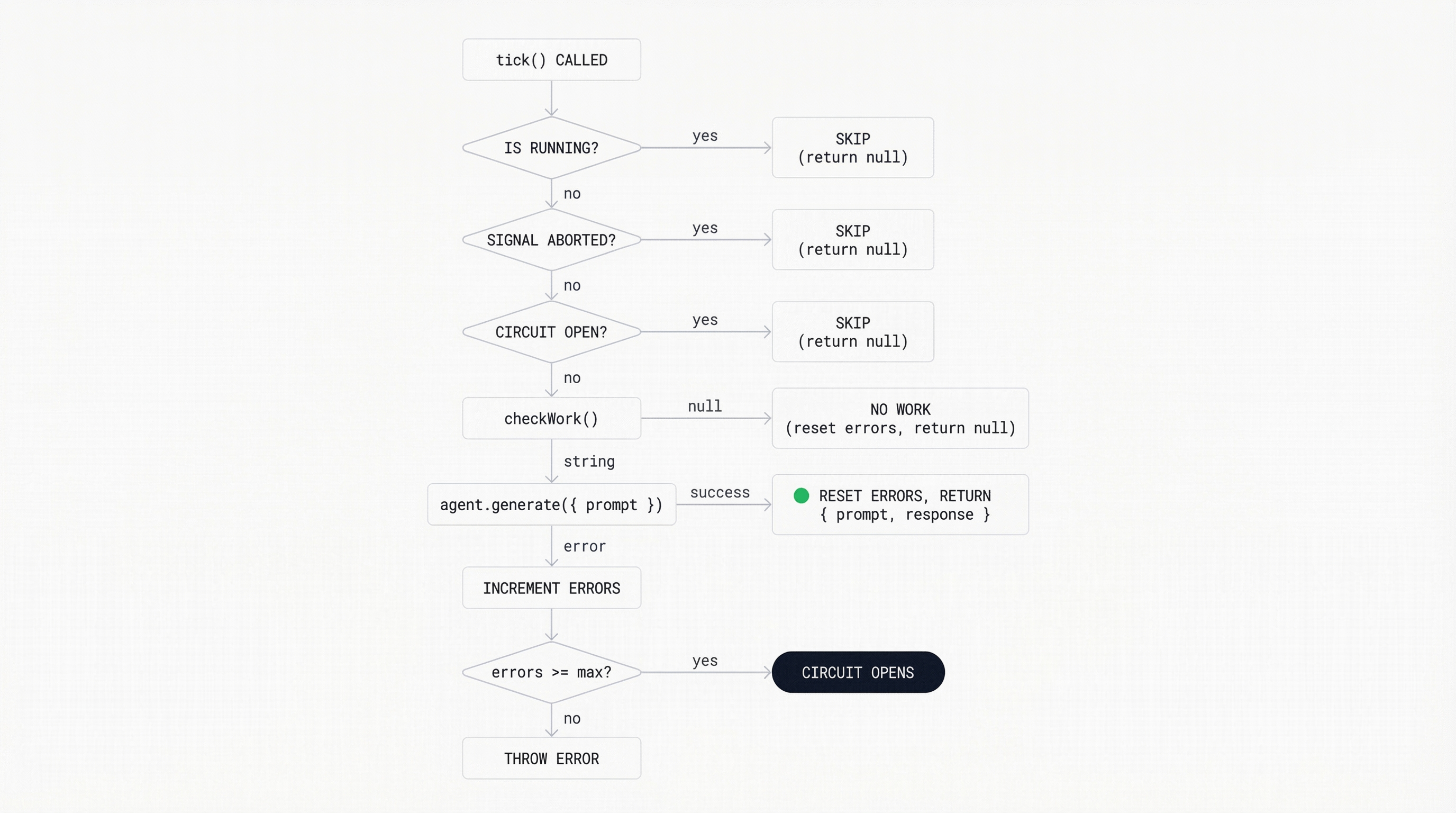
Circuit Breaker
After maxConsecutiveErrors (default: 5) consecutive failures, the circuit opens and all future ticks return null. The circuit state is persisted to the MemoryStore under the key heartbeat:state.
A successful checkWork() call (even returning null) resets the error counter.
AbortSignal
const controller = new AbortController();

const heartbeat = createHeartbeat(agent, {
  checkWork: async () => { /* ... */ },
  signal: controller.signal,
});

// Later: stop the heartbeat
controller.abort();
Reference
EmployeeAgent constructor
| Parameter | Type | Description |
|---|---|---|
config.model | LanguageModel | AI SDK language model |
config.instructions | string? | System prompt |
config.id | string? | Agent identifier |
config.tools | TOOLS? | Tools the agent can use |
config.membrane | Omit<MembraneConfig, 'tools'>? | Membrane config (tools passed separately) |
config.memory | { store: MemoryStore, config?: MemoryPrepareStepConfig }? | Memory injection |
config.prepareStep | PrepareStepFunction | PrepareStepFunction[]? | Additional prepareStep functions |
config.stopWhen | StopCondition | StopCondition[]? | Stop conditions |
config.onStepFinish | (event) => void? | Step finish callback |
config.onFinish | (event) => void? | Generation finish callback |
config.maxSteps | number? | Max steps fallback. Default: 20 |
createHeartbeat(agent, config)
| Parameter | Type | Description |
|---|---|---|
agent | { generate: (options: { prompt: string }) => Promise<unknown> } | Any agent-like object |
config.checkWork | () => Promise<string | null> | Check for work. null = no work, string = prompt |
config.state | MemoryStore? | Store for state persistence |
config.maxConsecutiveErrors | number? | Circuit breaker threshold. Default: 5 |
config.signal | AbortSignal? | Cancellation signal |
Returns: HeartbeatResult
| Property | Type | Description |
|---|---|---|
tick() | Promise<{ prompt, response } | null> | Execute one tick |
isRunning() | boolean | Whether a tick is in progress |